Suppose a basketball player make N shots,
and we know that in the first n(≤N) shots he sinked m(≤n) shots.
If from the (n+1)th shot,
his ratio of sink a shot is his accumulative ratio before the shot,
e.g., suppose he sinked 40 shots in the first 50 shots,
then his ratio of sink the next shot is 80%.
What’s the probability that he will make M shots finally?
Using the knowledge of permutation and combination, we can solve this problem directly.
Let Em,n be the event that m success in the first n shots.
It turns out to be that
i.e., the number of sinked shots M is uniformly distributed on its support
given that the player only sinked 1 shot in the first 2 shots.
Let Xk,n≤k≤N be the number of shots the player sinks in the first k shots,
then the distribution of Xk+1 conditioning on Xk is given in Table 1.
Using the similar method as we’ve done in the first 3 problems,
we can easily find the first and second moment of Xk which are given below:
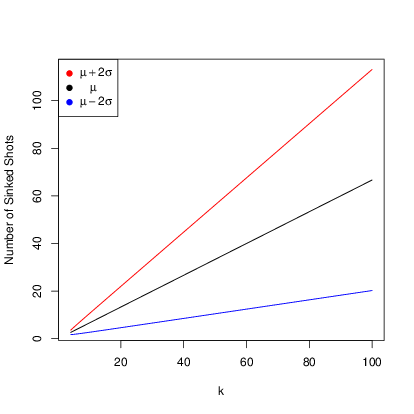
From the above formulas, we can know that the expectation and variance
of the number of sinked shots are linear quadratic functions of k respectively,
and both of them increase as k increases.
This makes it hard for us to predict Xk when k is big.
The 2-σ intervals for Xk is shown in the follow figure.
Since we know the distribution of the number of sinked shots
given that the player sinked m shots in the first n shots,
we can calculate the first and second moments directly,
which yields the following equations: